Drops of Knowledge – Discovering Black Sea Facts & Figures
BSEC Countries Edition - Republic of Türkiye
22 January 2026
The International Centre for Black Sea Studies (ICBSS) has launched the Drops of Knowledge – Discovering Black Sea Facts & Figures “BSEC Countries Edition”.
Thirteen infographics -one for each of the thirteen BSEC Member States- with the aim to provide comprehensive information of key socioeconomic indicators, such as population, unemployment, education, economy, and climate change. The infographics are published monthly.
The twelfth infographic focuses on the Republic of Türkiye.
HIGHLIGHTS
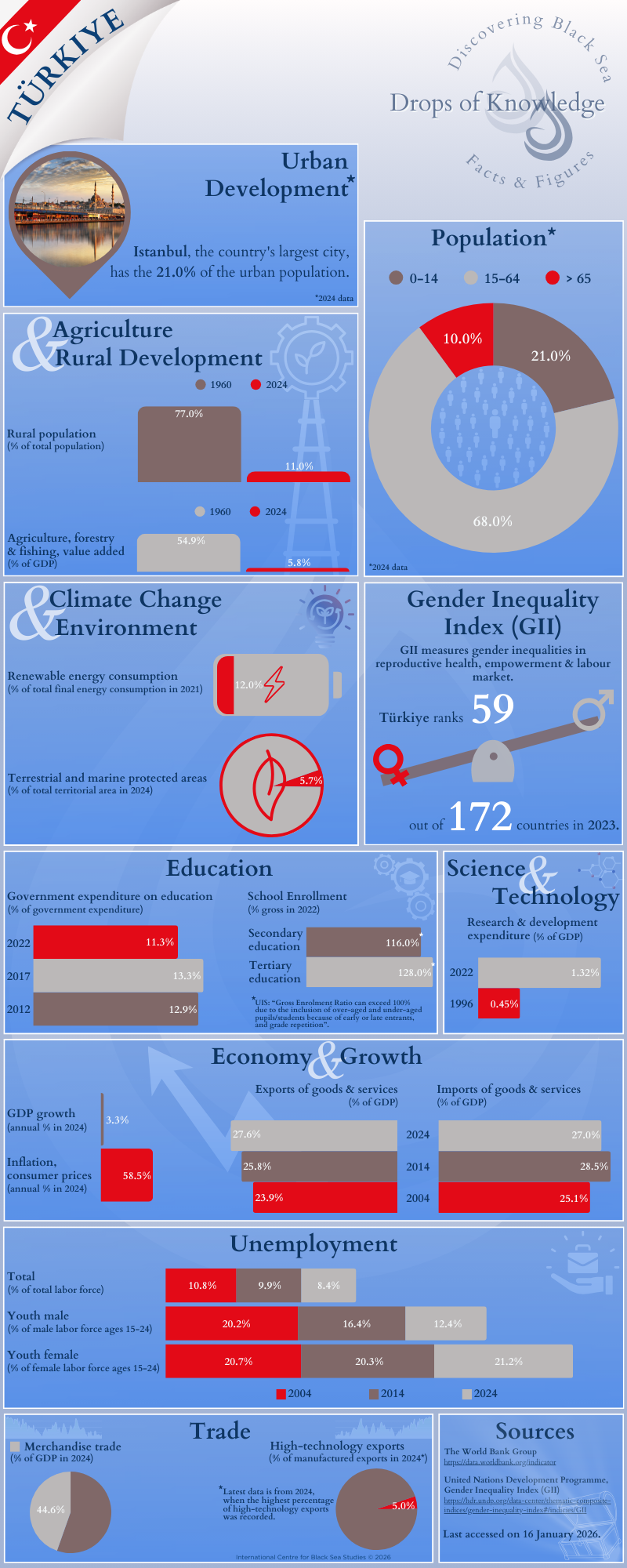
- Urban Development: 21% of the urban population lives in Istanbul, the country’s largest city (2024).
- Agriculture and Rural Development: 11% of the total population lives in rural areas, as of 2024. In 1960, the first year this indicator was recorded, the percentage of the rural population was 77%.
- Population: 68% of the total population is between the ages 15-64 (2024).
- Climate Change and Environment: 12% of the total final energy consumption comes from renewable energy sources (2021).
- Gender Inequality Index (GII): The GII measures gender inequalities in three key dimensions: a) reproductive health, b) empowerment, c) and labour market. Reproductive health is measured by maternal mortality ratio and adolescent birth rates; empowerment is measured by the shares of parliamentary seats held and population with at least some secondary education by each gender; and labour market participation is measured by the labour force participation rates for women and men. In 2023, Türkiye ranks 59 out of 172 countries.
- Education: During the last decade (2012-2022), government expenditure on education has decreased from 12.9% to 11.3%.
- Science and Technology: In 2022, the most recent year for which data is available, gross domestic expenditures on research and development (R&D) are 1.32%. In 1996, the first year in which this indicator was recorded, the percentage was 0.45%.
- Economy and Growth: In 2024, the annual percentage growth rate of GDP is 3.3%, while inflation as measured by the consumer price index is 58.5%. Over the last twenty years (2004-2024), exports of goods and services have increased from 23.9% to 27.6%, while imports have increased from 25.1% to 27%.
- Unemployment: Over the last twenty years (2004-2024), unemployment of the total labour force has decreased from 10.8% to 8.4%. Male youth unemployment decreased from 20.2% to 12.4%, while female youth unemployment increased from 20.7% to 21.2% (labour force ages 15-24, modelled ILO estimate).
- Trade: 2024, the most recent year for which data is available, saw the highest percentage of high-technology exports of all years, at 5% of manufactured exports.
**In 2022, Türkiye has a school enrolment ratio in secondary education of 116% (% gross) and in tertiary education of 128% (% gross). As the UNESCO Institute for Statistics (UIS) mentions, “Gross Enrolment Ratio (GER) can exceed 100% due to the inclusion of over-aged and under-aged pupils/students because of early or late entrants, and grade repetition”.
Sources:
The World Bank Group, https://data.worldbank.org/indicator
United Nations Development Programme, Gender Inequality Index (GII), https://hdr.undp.org/data-center/thematic-composite-indices/gender-inequality-index#/indicies/GII
UNESCO Institute for Statistics (UIS), https://uis.unesco.org/en/glossary
All last accessed on 16 January 2026.