Round-Table Discussion
The environmental impact of the war on the Black Sea
Friday 22 May 2026 | Athens (Hybrid)
Press-release | Video
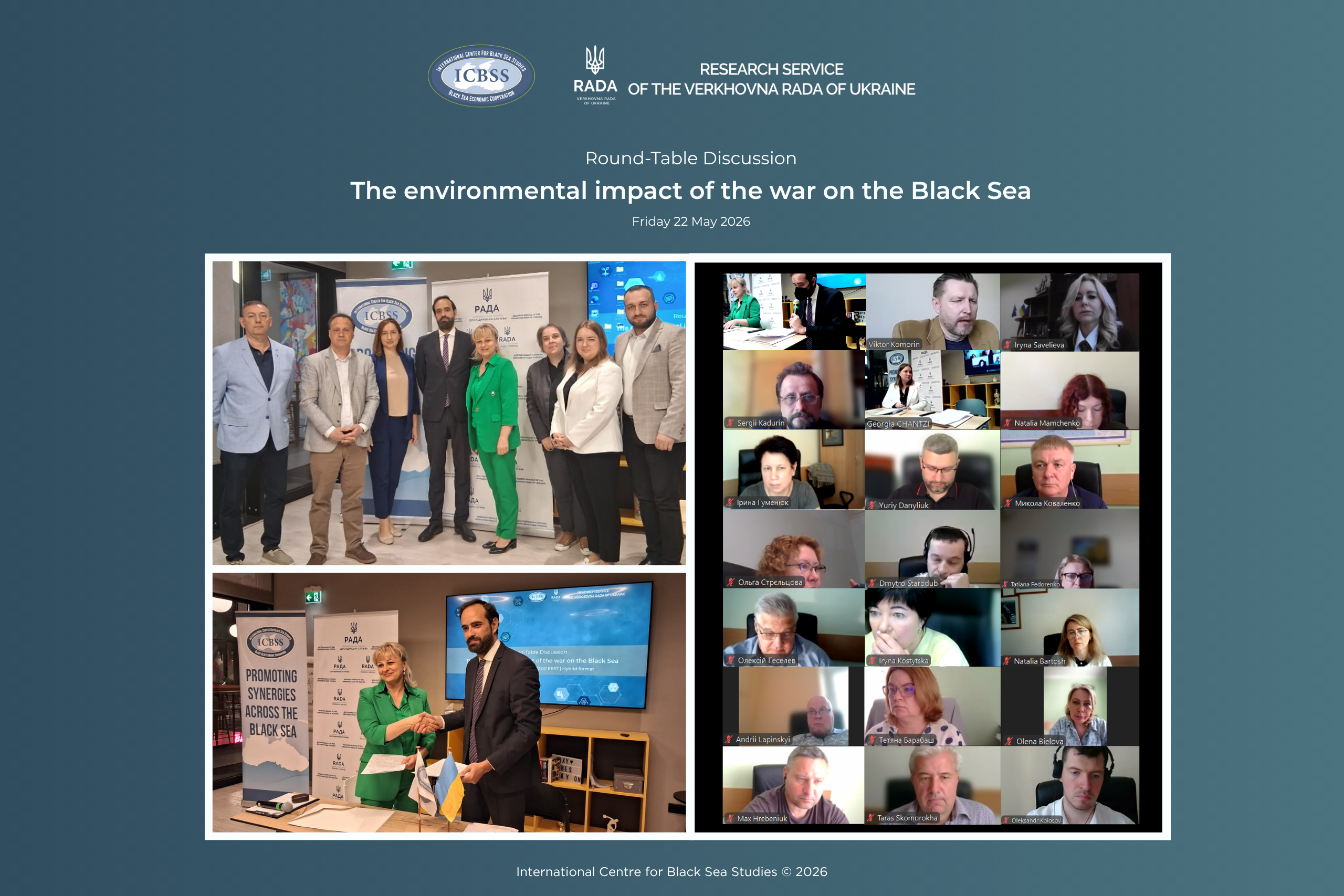
On Friday 22 May 2026, the International Centre for Black Sea Studies (ICBSS), in cooperation with the Research Service of the Verkhovna Rada of Ukraine, organised successfully the Round-Table Discussion "The environmental impact of the war on the Black Sea", held in a hybrid format, in Athens, Greece.
On the occasion of the official visit of the delegation of the Research Service of the Verkhovna Rada in Athens, the event aimed to raise awareness on the direct and indirect environmental impact of military activities and mobilise stakeholders in efforts to safeguard the ecological value and economic resilience of the Black Sea. The event gathered 50 online and onsite participants, mainly from policy and academia. [Concept Note]
Key takeaways:
-
- The Black Sea basin faces a war-induced environmental crisis with both ecological and socioeconomic implications.
- The environmental impact of the war extends beyond the Ukrainian borders, to affect the entire Black Sea region and waterways linking the Mediterranean Sea and the Danube
- War-related environmental pressures aggravate existing stressors in the Black Sea. The full extent of the consequences is not entirely visible yet and is likely to affect future generations.
- Indirect implications include the weakening, or even suspension, of systematic research and analysis, as well as of monitoring systems, resulting in limited responsive measures and enforcement of safety regulations.
- A collective response that prioritises environmental recovery alongside humanitarian and political solutions is already needed.
- Priority should be given on facilitating continuous cooperation and knowledge exchange among the scientific communities within the Black Sea, as well as with other regions, such as the Baltic Sea.
- Science advocacy will support policy and decision-makers to focus efforts where are most needed.
- Institutional engagement and cross-border synergies are pivotal for effective recovery and mitigation actions to have measurable results.
About the event
Opening the event on behalf of the organisers, Dr. Lesia A. VAOLEVSKA, Head of the Research Service and Mr. Georgios MITRAKOS, ICBSS Director General delivered the opening speeches.
During the keynote speech, Dr. Viktor KOMORIN, Deputy Director for Science at the Ukrainian Scientific Center of Ecology of the Sea (UkrSCES), presented 'The war threatens marine ecosystems: the impact of Russia's aggression on the Black Sea' (2025), a report on the environmental crisis extending beyond Ukraine’s borders to affect the entire Black Sea region and waterways linking the Mediterranean Sea and the Danube. Dr. Komorin stressed the need to act now, identifying three key priorities for action: a) creation of an up-to-date regional environmental database to facilitate continuous monitoring, b) development of advanced tools, such as digital twins, to understand the impact, and c) science advocacy to help the decision-makers understand where action is most needed. [Komorin Presentation]
Opening the round-table discussion, Dr. Iryna SAVELIEVA, Acting Rector at the Odesa National Maritime University (ONMU), noted that “the environmental crisis is not only an ecological issue, but a socioeconomic too” and outlined three plausible scenarios for the Black Sea by 2035: a) frozen conflict, b) recovery without coordination, c) joint regional cooperation, with the third providing a more result-oriented response for recovery in the Black Sea basin. [Savelieva Presentation]
From Odesa I. I. Mechnikov National University, Dr. Serhii KADURIN, noted that coastal erosion and sedimentation are grave challenges for the Black Sea coastline and stressed that among the most crucial war implications is the suspension of systematic research along the Black Sea coast, that severely limits coastal protection measures and intensifies destructive coastal processes. [Kadurin Presentation]
Concluding the session on behalf of the Research Service of the Verkhovna Rada, Dr. Anna KONDRATOVA, emphasized three priorities to facilitate joint coordination actions in the Black Sea: a) cross-border cooperation of researchers to support evidence-based policies and decisions, b) stronger cooperation among institutions, i.e. parliaments, governments, academia, international organisations, and c) adoption of a common vision for the Black Sea region; a new model for sustainable regional development in the post-war period, based on Blue Economy as a key economic driver.
In the sidelines of the event, the Director General of the International Centre for Black Sea Studies and the Head of the Research Service of the Verkhovna Rada of Ukraine officially signed a Memorandum of Understanding between the two institutions, following the online ceremony held in December 2025.
Read the full Press-Release HERE
Context
Now in its fourth year, Russia’s war against Ukraine has had significant impact on the environment, affecting natural ecosystems, food security, and livelihoods. The consequences are severe and multifaceted, with spillovers extending beyond the frontlines. Adding these to the existing environmental pressures affecting the Black Sea, the environmental damage is likely to impact future generations; yet the prospects of ecological recovery remain uncertain.
The Round-Table Discussion "The environmental impact of the war on the Black Sea" brought together experts from policy and academia to exchange on the direct and indirect environmental impact of the war on ecosystems in the Black Sea. Discussions aimed to foster coordinated research, policy responses, and international cooperation with a view to safeguarding the ecological value and economic resilience of the Black Sea.
Objectives
-
- To enhance public understanding on the environmental consequences of military activities.
- To highlight scientific efforts and practices to support evidence-based actions and policies.
- To raise awareness and foster cooperation among regional stakeholders for mitigation and recovery.